commPlane
A personal tool that turns neighborhood flyover complaints into evidence: 217 screenshots into incident records, and a privacy-first iPhone app for logging what comes next.
My neighborhood sits under training routes from a nearby airport. Neighbors had a flight-tracking app and a complaint form. That was it. Airspace is federal, so you can’t ban the planes — you can only push for operational change with specific, coordinated evidence.
commPlane is a passion project I started in May 2026 from screenshots I’d been saving since February. I defined it, designed it, and built it with AI coding agents. Two parts: a Python pipeline that turns screenshots into incident records, and a SwiftUI app that lets residents keep the record going without leaking where anyone lives.
Pipeline. OCR pulls the tail number. FAA registry adds owner and type. Historical weather lands on the timestamp. Noise is modeled with named corrections (ISO 9613-2). Altitude flags sit next to the model, not as a legal ruling. Two hundred seventeen screenshots became records: 87 distinct aircraft, 26 below the §91.119 floor for congested areas.
App. Log taps once when a plane is overhead. Flyovers holds the running list. Story builds the advocacy summary and a PDF. The full incident stays on the phone. The opt-in community pool gets rounded location, shifted time, and a rotating anonymous ID. Complaint identity lives in the Keychain and never syncs.
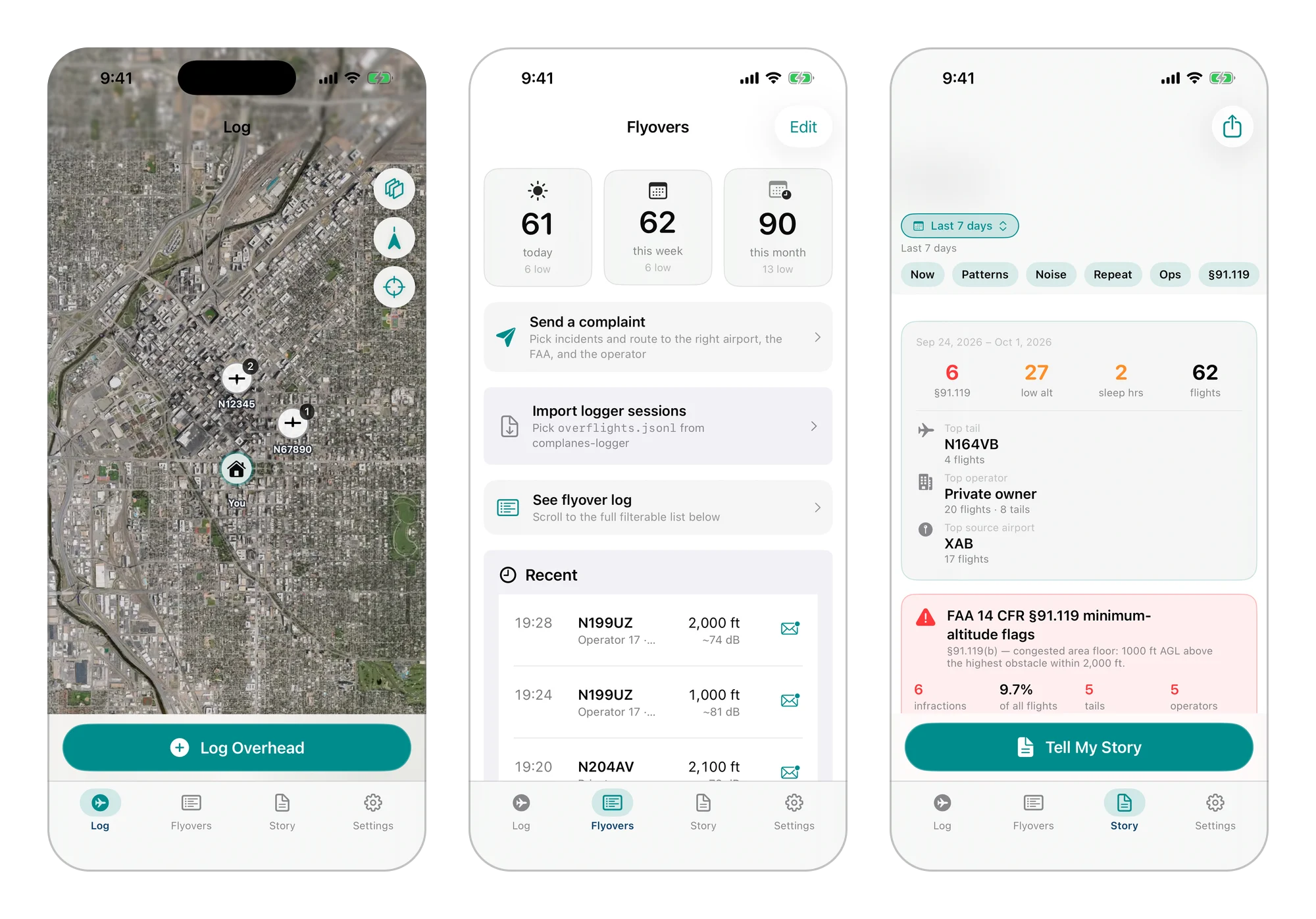
Log, Flyovers and Story. Simulator build with fabricated demo data — tail numbers and airports are not real. Never naming the town or airport keeps my home off the page.
How I worked. A living PRD and numbered change requests (most from voice memos). Agent reviews and a usability pass closed findings in code. Still building: phone-mic noise tied to one aircraft, and an always-on logger so the record doesn’t depend on a tap.