At a glance
- Problem
- Kelty wanted a micro chair that unfolds without assembly, but its concept used many moving pivots, wasn't robust, and would be hard to manufacture.
- My role
- Brought in to model Kelty's design; proposed and developed a simpler mechanism in Fusion 360 and 3-D printed prototypes.
- Result
- A single-hub chair that opens like an umbrella, proven in motion studies and printed prototypes. Kelty paused the project.
- Client
- Kelty
- Role
- Consulting industrial designer: mechanism concept, Fusion 360 modeling and motion studies, 3-D printed prototypes
- Timeframe
- 2020–2021
- Team
- Worked with Kelty's design manager
- Disciplines
- Mechanism Design · Prototyping · 3-D Printing
- Outcome
- Redesigned around a single hub; working printed prototypes; Kelty paused the project
- Client
- Kelty
- Role
- Consulting industrial designer: mechanism concept, Fusion 360 modeling and motion studies, 3-D printed prototypes
- Timeframe
- 2020–2021
More details
- Team
- Worked with Kelty's design manager
- Disciplines
- Mechanism Design · Prototyping · 3-D Printing
- Outcome
- Redesigned around a single hub; working printed prototypes; Kelty paused the project
Context
Micro chairs are the small, packable camp chairs that fold down to the size of a water bottle. Most of them arrive as a bundle of shock-corded poles that you assemble into a frame, then stretch a seat over.
In 2020, Kelty’s design manager asked me to help model a micro chair the team had designed. Kelty wanted a chair that unfolds itself, with no assembly, unlike traditional micro chairs.
Problem
Once I started modeling it, I found problems with the design. It used several moving pivot points, it wasn’t going to be robust enough, and it would have been complicated for Kelty’s manufacturers to make. The design also wasn’t finalized. Instead of just modeling it, I proposed a different mechanism that could reach the same goal.
- Unfold, don’t assemble The chair had to open on its own, unlike pole-and-hub micro chairs.
- Many moving pivots Kelty’s concept spread the motion across several pivot points.
- Weak and hard to make More moving parts meant less robustness and a harder build for manufacturers.
- One hub to carry the motion Consolidating the pivots into one hub made it stronger and simpler to assemble.
Constraints
- Unfold and expand without the user assembling poles.
- Be robust enough to sit in, with a mechanism Kelty’s manufacturers could build.
What I did
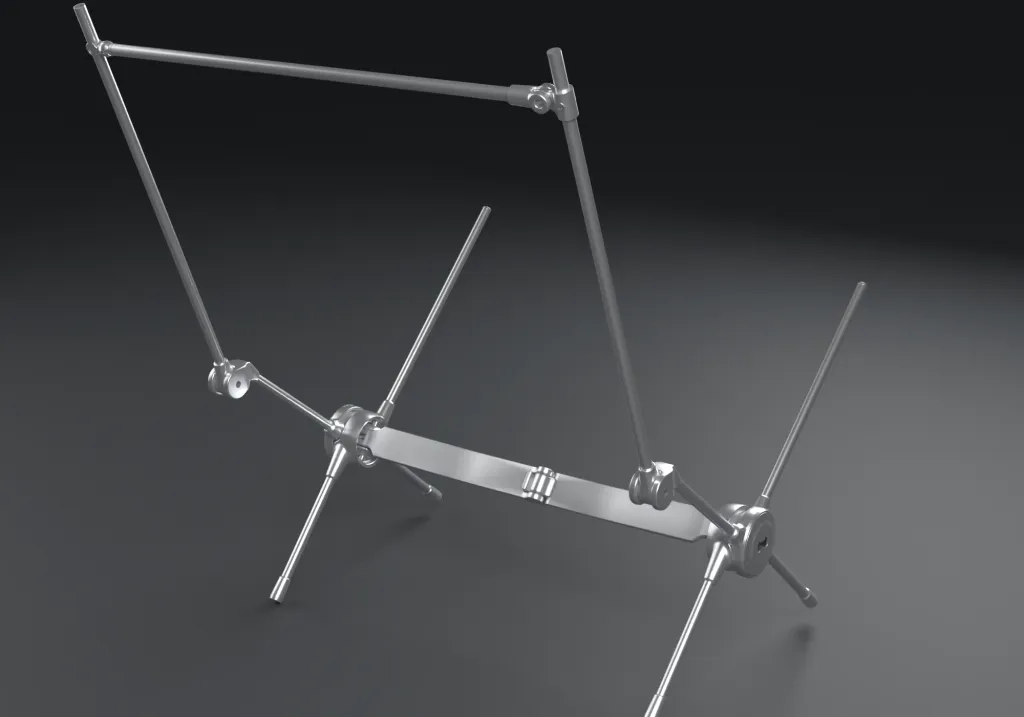
The key move: one larger hub instead of many moving pivots. I made the hub larger and the mechanism simpler, consolidating the pivots into a single hub. The hub parts are easier to assemble, and the frame unfolds and expands somewhat like a kinematic umbrella.
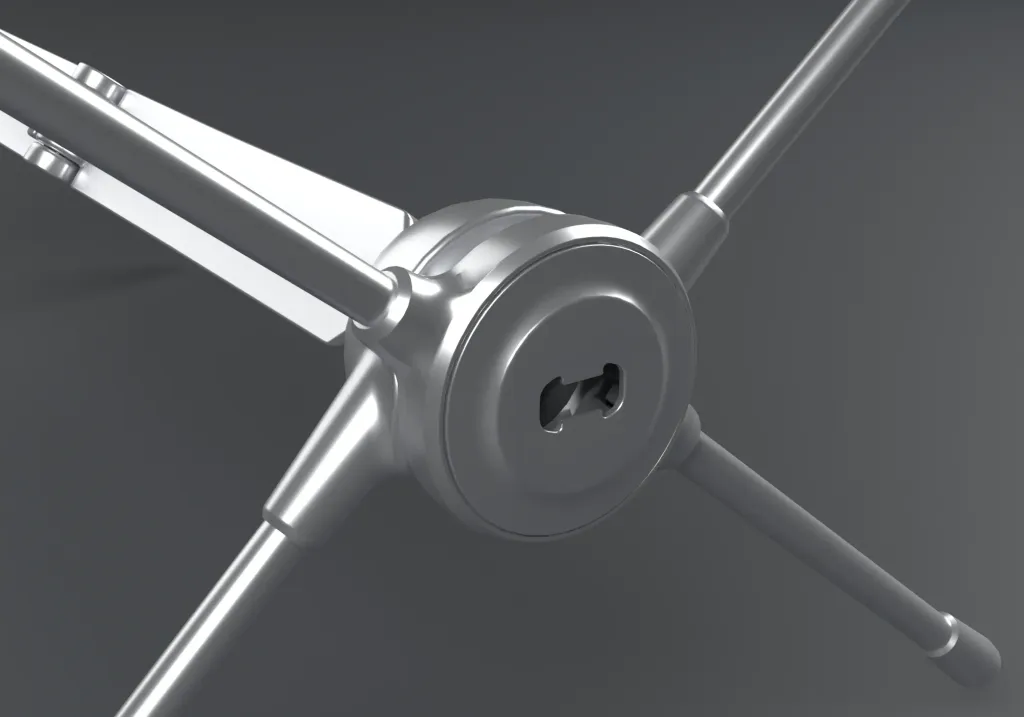
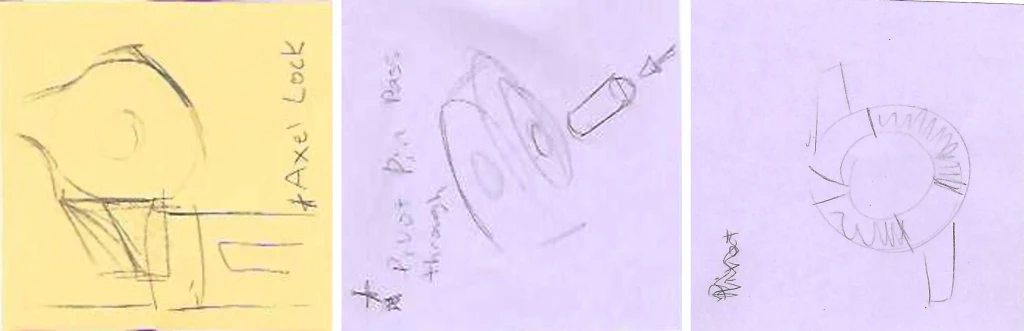
Then I worked the details out on paper. My sketch notes cut the number of axle parts, moved the arm pivot to the top of the axle with a rotational lock on the knuckles, and added a pivot to the back arm supports.

Then I modeled the motion. I learned Fusion 360 on this project, and used it to capture how the frame moves from folded to open. Getting a kinematic system like this to model correctly, and to show its movement, was the hardest part.

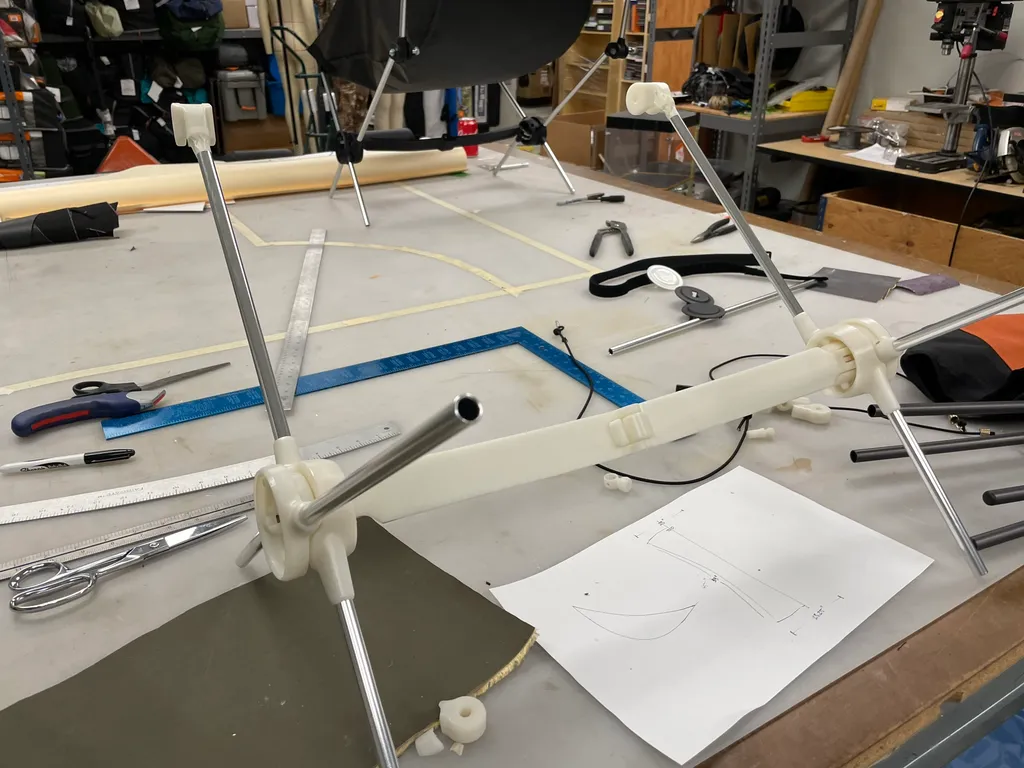
Then I printed it. I 3-D printed the hubs and fitted them to aluminum poles to check the mechanism and fit, on bare frames and with the fabric seat on.

Outcome
The redesign worked in motion studies and in printed prototypes, and I carried the model through to a final high-back version. Kelty then paused the project.

1 hub
Review
I learned Fusion 360 on this project, and how complicated kinematic systems are: hard to model, and even harder to capture in motion. It was a challenging project, and insanely fun because of how challenging it was.

