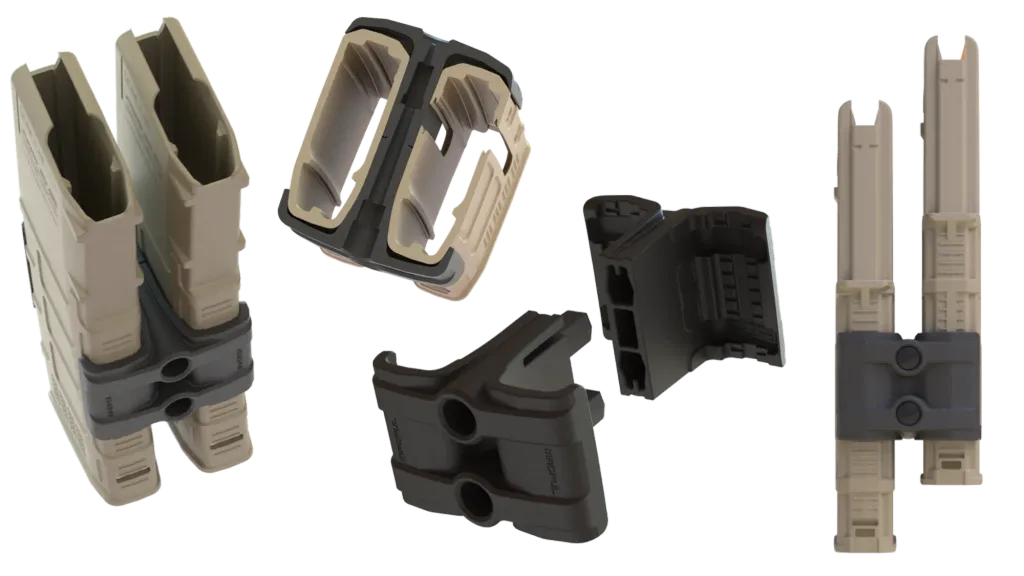
At a glance
- Problem
- Shooters taped spare magazines together, and a competitor was selling a coupler for Magpul's own PMAGs.
- My role
- Owned the design end to end: sketches, CAD, FEA, prototypes, drop and feed testing, and tooling hand-off.
- Result
- Launched in 2012 as the Maglink (MAG595); still in Magpul's line, with a National Stock Number and two US design patents.
- Client
- Magpul Industries
- Role
- Industrial designer: concept, sketching, CAD, FEA, prototyping, testing, and tooling hand-off
- Timeframe
- 2010–2012
- Team
- Owned end to end; Brian Nakayama helped develop the stiffening geometry
- Disciplines
- Defense · Injection Molding · DFM
- Outcome
- Still sold by Magpul 14 years after launch; 2 US design patents
- Client
- Magpul Industries
- Role
- Industrial designer: concept, sketching, CAD, FEA, prototyping, testing, and tooling hand-off
- Timeframe
- 2010–2012
More details
- Team
- Owned end to end; Brian Nakayama helped develop the stiffening geometry
- Disciplines
- Defense · Injection Molding · DFM
- Outcome
- Still sold by Magpul 14 years after launch; 2 US design patents
Context
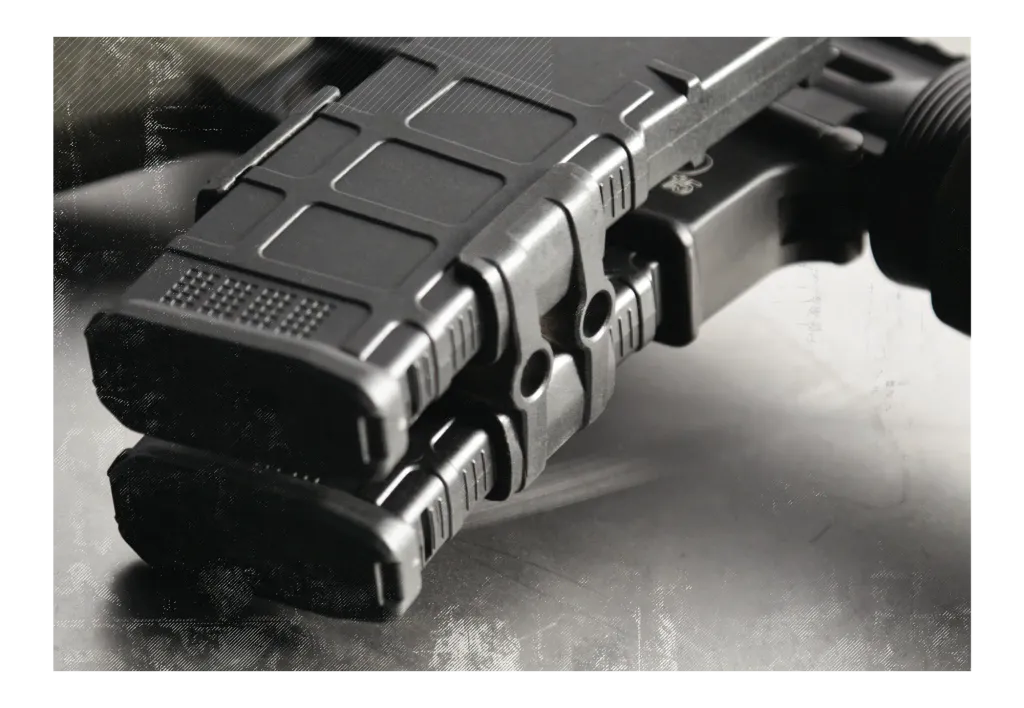
Magpul’s PMAG is a polymer rifle magazine. Coupling two of them side by side keeps a loaded spare on the rifle: when one runs dry, a small sideways shift puts the next one in the magwell.
As an industrial designer at Magpul, I was asked to create a part that joins two rifle magazines. I owned it end to end, from the first sketches through CAD, analysis, prototypes, testing, and hand-off to tooling. It was the first design of mine to become a physical product.
Problem
Coupling magazines wasn’t new, but nothing on the market was Magpul’s. Before couplers, people mostly used tape. Then a competitor released a coupler for PMAGs, and Magpul decided it needed its own, built to its own performance standard.
- Tape was the default Shooters taped spare magazines together to keep a reload on the rifle.
- A competitor moved in Another company sold a coupler for PMAGs that joined them at the floor plates.
- Magpul’s mags, someone else’s performance How a coupled PMAG held up depended on a part Magpul didn’t control.
- A Magpul coupler, to a Magpul standard Magpul wanted a part that performed like the magazines it carried.
Constraints
- Fit the PMAG 30 and the new PMAG 30 M3 without affecting how either one feeds.
- Survive drop testing and hold the magazines firmly under high rates of fire.
- Mold in glass-filled nylon.
Use a simple two-plate (A/B) mold with no slides: an eight-cavity family tool that produces both halves of four couplers per shot, for fast cycle times.
- Clamp hard enough to hold, without deforming the magazines.
What I did
The key move: clamp the bodies, not the floor plates. My first direction followed the competitor and joined the magazines at the floor plates. To stay stiff there, the part needed so much material that it got bulky, hindered mobility, and handled poorly. The final design clamps around the magazine bodies instead. It’s deliberately a little flexible, so users can adjust the configuration to their needs.
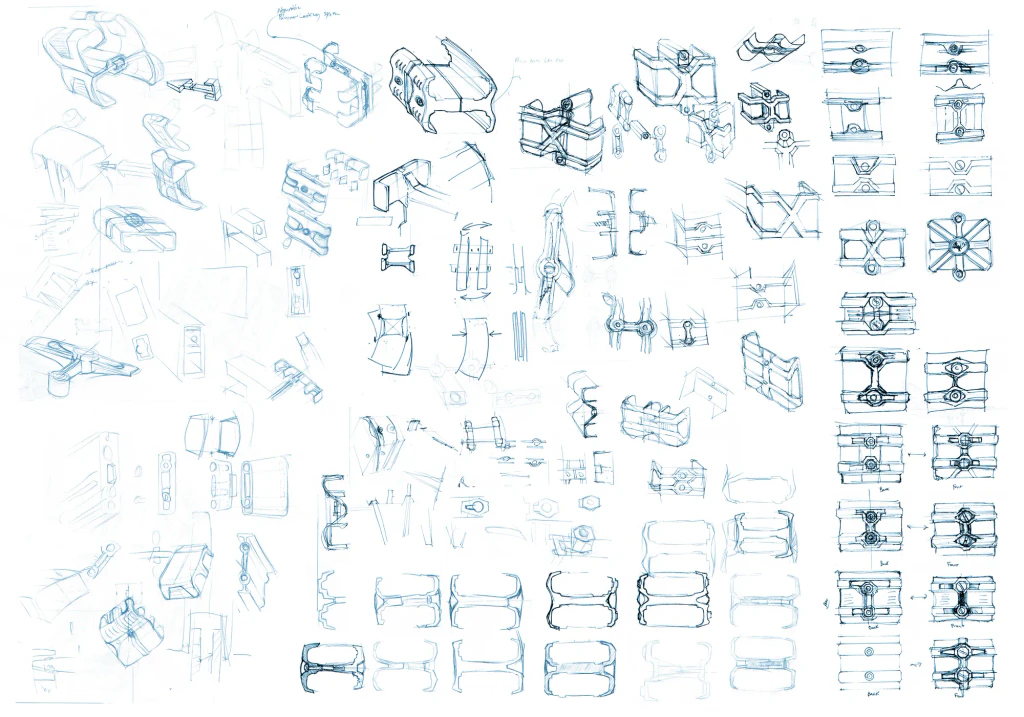
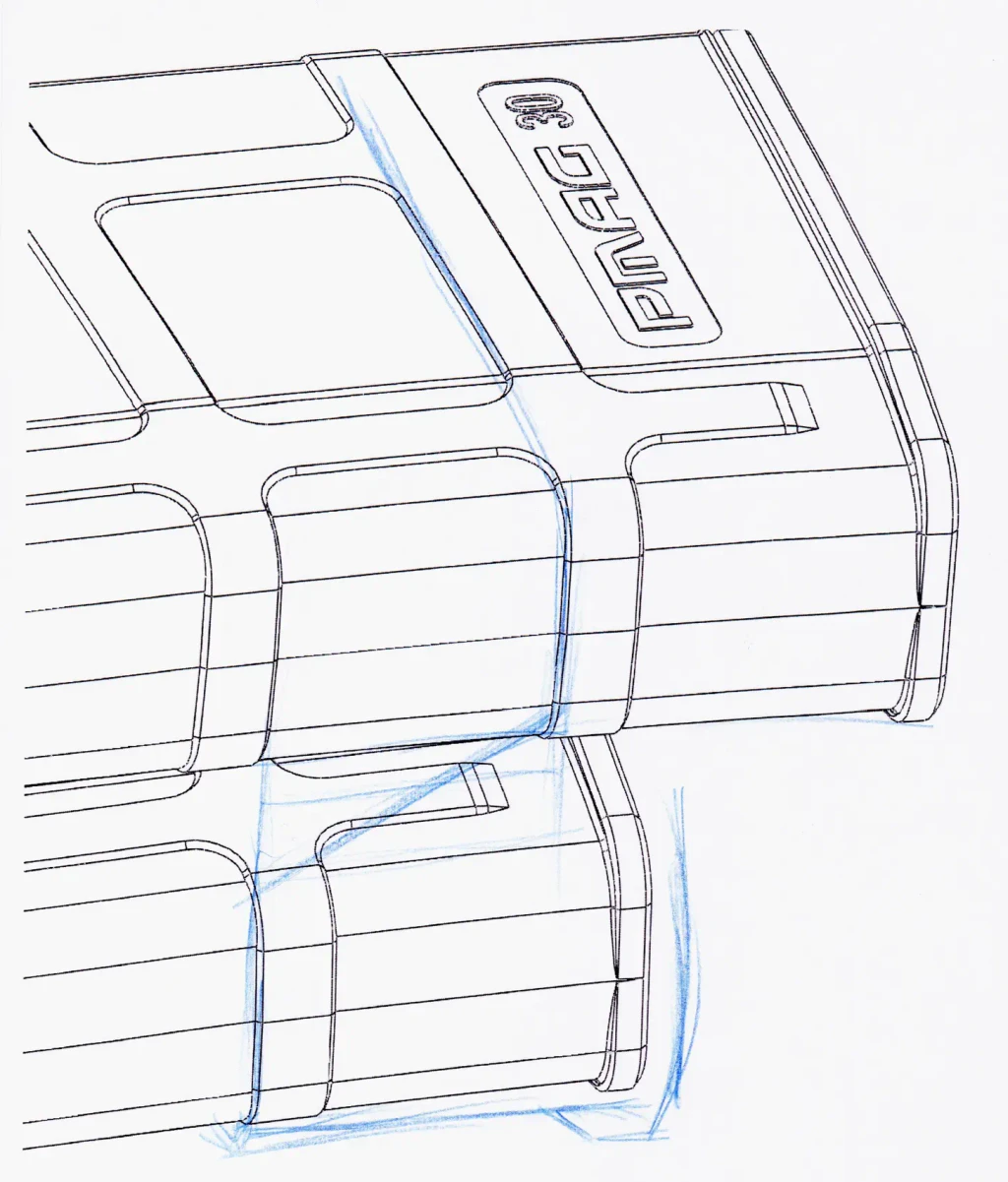
Then I designed the rest of the system around it.
Split the coupler into two halves that bolt together into a nut captured in one side, so it installs with a flat-head screwdriver.
Added grooves inside each half that lock into the PMAG’s ribbing, so the magazines can’t slip.
Added internal stops that keep it from being overtightened, so the clamp can’t deform the magazines. I used the bolts and captured nut to calculate the compression it applies.
Ran my own FEA (finite element analysis) on crush, splay, and push-out loads. Brian Nakayama helped me develop the geometry that made the structure stiffer.
Designed both halves to run together in the eight-cavity family mold.
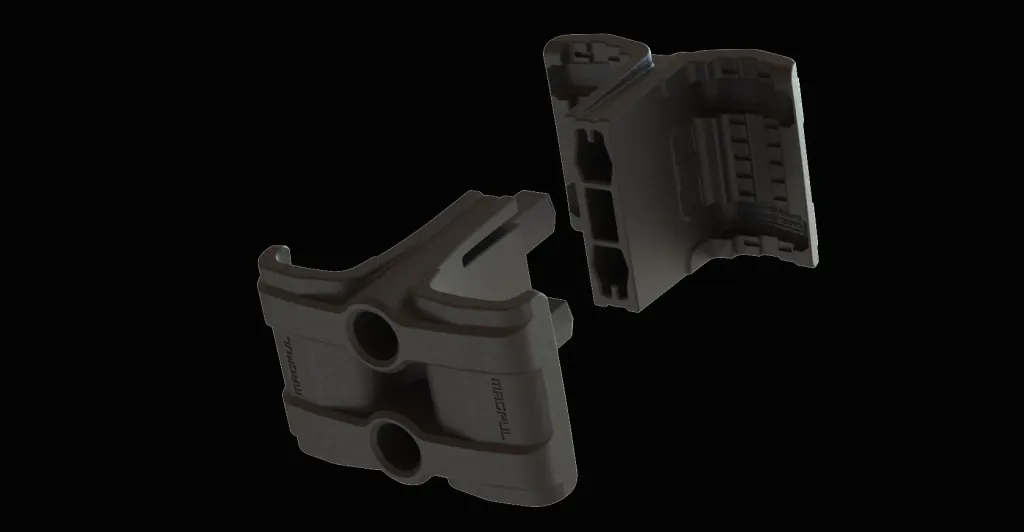
Then I tested it. The coupler passed drop testing on the first try. It held the magazines firmly and didn’t affect feeding when we tested it on high-rate-of-fire weapons. The prototypes tested well, and the first production parts did even better. The turnaround from finished CAD to those first production parts was very short.
Outcome
Magpul announced the Maglink alongside the PMAG 30 M3 in January 2012 (Jerking the Trigger) and released it in May 2012 at $17.95 (Gun News Blog). It’s still sold today as the MagLink® Coupler (MAG595), now for 30 and 40-round PMAGs. It has a National Stock Number, so it can be ordered through the US military supply system.
14 years
USD689581: magazine link for firearm magazines. Filed May 2012, granted September 2013, assigned to Magpul Industries.
USD720422: magazine link for firearm magazines, a follow-on design. Filed September 2013, granted December 2014, assigned to Magpul Industries.
- Rated 4.7 out of 5 from 91 reviews at one large retailer (Primary Arms).
Review
This was the first design of mine to become a physical product, and it went from start to finish amazingly fast. Many of my later projects took much longer to mature. The difference was clear requirements that were easy to obtain: a known magazine, a known mold strategy, and a clear performance bar.