At a glance
- Problem
- A spinal cord stimulation programmer had to drive directional brain stimulation across two hemispheres.
- My role
- Designed the clinician programmer UI and ran usability work, reviewing directly with Aleva.
- Result
- The design shipped in the CE-marked directSTIM system (2019); FDA approved a US IDE study (2022).
- Client
- Aleva Neurotherapeutics (via Nuvectra)
- Role
- Usability Engineer / UX Designer — clinician programmer UI/UX, usability engineering, patient programmer adjustment
- Timeframe
- 2017–2019
- Team
- Nuvectra software and systems engineering; Aleva clinical and engineering reviewers
- Disciplines
- Biotech · Embedded System · Usability Engineering · Regulatory Documentation
- Outcome
- Shipped in the CE-marked system (2019); FDA-approved US IDE study (2022)
- Client
- Aleva Neurotherapeutics (via Nuvectra)
- Role
- Usability Engineer / UX Designer — clinician programmer UI/UX, usability engineering, patient programmer adjustment
- Timeframe
- 2017–2019
More details
- Team
- Nuvectra software and systems engineering; Aleva clinical and engineering reviewers
- Disciplines
- Biotech · Embedded System · Usability Engineering · Regulatory Documentation
- Outcome
- Shipped in the CE-marked system (2019); FDA-approved US IDE study (2022)
Context
Aleva Neurotherapeutics, an EPFL spinoff in Lausanne, built a deep brain stimulation (DBS) lead with directional electrodes for Parkinson’s disease and essential tremor. Instead of building a system from scratch, Aleva licensed Nuvectra’s Algovita spinal cord stimulation platform: the implanted pulse generator, the clinician programmer tablet, and the patient programmer-charger.

My title was Usability Engineer / UX Designer at Nuvectra. On directSTIM I designed the clinician programmer interface, ran the usability engineering, adapted Algovita’s widgets to the brain, designed the patient programmer’s amplitude adjustment, and reviewed the work directly with Aleva’s clinical and engineering team.
Problem
The platform was built for the spine; the brain needed directional control and a way to see the therapeutic window. A DBS patient has two leads, one in each hemisphere, each with twelve independent electrodes. Clinicians search for the electrode and current that relieve symptoms without side effects. When I joined, the screens showed that search as a grid of numbers.
- Reuse a spine platform directSTIM leveraged Algovita’s pulse generator, programmer, and software to save time and cost.
- The brain needs direction Two leads, one per hemisphere, with twelve independently controlled electrodes each.
- Electrodes as a grid The starting screens showed electrodes as numbered cells, not as positions in the brain.
- Search by trial Clinicians test combination after combination, scoring benefit against side effects, often during surgery.
- Slow, error-prone programming Hard-to-read values and unclear states cost time in the operating room and invite mistakes.

Aleva’s review comments pointed at the same gaps in the screens themselves:
- Electrode numbers, amplitudes, and the patient name in the status bar were hard to read.
- Active electrodes and selected electrodes looked the same.
- The therapeutic window wasn’t drawn to scale with the current in mA.
- A full lead integrity check took a long time, with no warning and no progress shown.
Constraints
- Reuse the off-the-shelf Algovita programmer tablet, patient programmer, and existing widgets.
- FDA and CE design controls: traced requirements, verification, validation, and risk management.
- Hard safety limits: 30 µC/cm² charge density, 30 mA per pulse generator, 15 mA per electrode.
- A partner team in Switzerland, reviewing by written comments and in person in Denver.
What I did
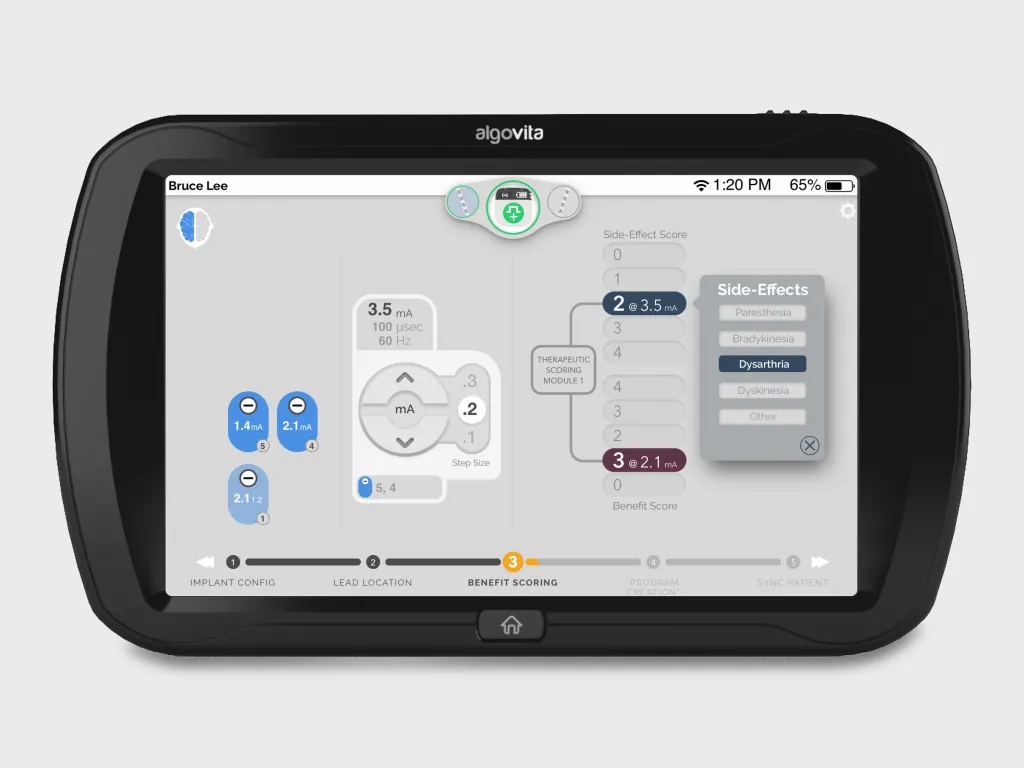
The key move: put the lead on the brain, not in a grid. The first task a clinician has is to find where the lead actually sits and which electrodes face the target. I split that into physical location and effective location, and made the brain the frame for every programming step.


Then I designed the rest of the system around it. With the brain as the frame, I worked through the programmer screen by screen with Aleva:
- A central widget that shows both leads and the pulse generator. Tapping a lead switches it between monopolar and bipolar.
- Stimulation start and stop with ramping. The same control is the emergency stop, and the amplitude stepper blocks fast transients when tapped quickly.
- Side-effect types matched to Parkinson’s care (paresthesia, bradykinesia, dysarthria, dyskinesia), rolled up into a therapeutic effect board.
- Session types for intraoperative checks, initial programming, reprogramming, and lead integrity checks. Reprogramming jumps straight to the therapy overview.
- Program management, and a patient programmer amplitude slider whose maximum follows the charge-density and current limits.

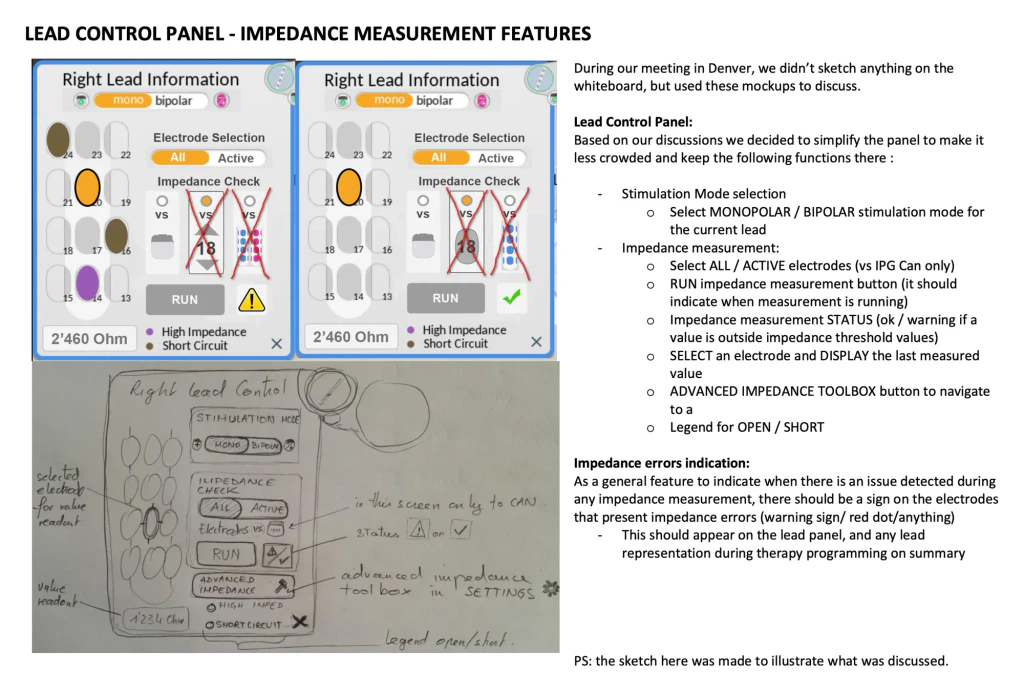
Late in 2017 we simplified the lead control panel. It kept only stimulation mode and impedance measurement, and open or short-circuit warnings now appear on every lead view, including the therapy summary.
Outcome
The design moved through iterative reviews with Aleva’s clinical and engineering team, and in 2018 I delivered the final UI assets for the directSTIM clinician programmer.
CE Mark
The released programmer kept the design. Aleva’s clinician manual shows the brain-framed therapy screen, the central widget with step sizes, ramped start and stop, blue and pink hemisphere coding, the simplified lead panel, and 0–4 side-effect and benefit scores with the therapeutic window between them, saved to an Effect Board.

Aleva sold the system through a post-market clinical study in European neurology clinics. In the first three patients reported, the therapeutic window with directional stimulation was 1.5 mA wider on average than with omnidirectional stimulation: the same window the scoring screen was built to capture.
Review
Platform reuse saves hardware, software, and regulatory work, but the interface is where one therapy differs from another. Reuse the widgets, not the mental model: start from the clinician’s first task, which here was finding the lead in the brain, and let the parameters follow.
It was also one of the most joyful projects I’ve worked on. The Aleva and Nuvectra team was highly collaborative, and the review loop above is what that looked like day to day.